Showing posts with label Cursive. Show all posts

Wednesday, March 22, 2017

An Open Letter to Groupmuse


Tomorrow, March 23rd at 8:00 pm, Tall Wind, the newest program by my chamber group Cursive, will see its one-night-only performance (deets in this link).  Cursive is a group dedicated to the ideals of this blog, shining a light on excellent classical music that has been swept under the rug by the establishment and history, though with a focus on music from the latter half of the 20th century.  This is our third program and features some of Seattle's best and most adventurous new music performers playing scarce works such as Tison Street's Variations for flute, cello and guitar and Chinary Ung's fabulous Tall Wind.  It's been a dream come true to be able to mount programs like this repeatedly and I hope all my musicians the best for tomorrow night.  I've been having a bit of trouble finding ways to use this blog to promote our cause, a risk that one takes when most of the programmed pieces lack recordings.  However, a situation presented itself just today which required my action and helped me expound on Cursive's cause.

Groupmuse is a community project that creates a framework for local chamber groups to do house concerts in any home in the greater Seattle area that signs up to host.  All the money gathered from seat sales goes to the musicians and hosts and audiences have an easy, safe way to get the chamber music experience in a comfortable and relaxed environment.  It's a great deal for everybody, especially the musicians, except for one caveat: at least half of the program has to be "standard rep".  Their reasoning (viewable here in their mission statement page) is that "standard rep" works have stood the test of time for their "substance and profundity", and that ensuring that some older works make it on to every concert keeps the artistic quality high.  For many soloists and groups they were going to perform a standard work anyways, so this isn't an issue, but it is for groups like mine, other modern groups and groups that just don't like having to make every program built around something you hear on the radio every day.  I've never considered submitting a Cursive program for their consideration because I know it'll be rejected solely based on the rep, but that doesn't mean that Groupmuse upholds this policy 100% of the time.  

The only Groupmuse performance I attended was one by Trio Pardalote wherein they performed Hans Krasa's Theme and Variations and Jean Cras's gorgeous String Trio, the latter being the reason I wanted to go.  Neither of these works is in the "standard rep" but both have what could be called cult followings.  It was a great concert but was a bit deceptive, as it gave me hope that I could make a program that was as "standard" as that and get it selected.  I made a piano recital program of British Impressionist works, pieces that were not only rarely heard but that general audiences would probably really like, and submitted it only to have it rejected multiple times.  One could argue that I'm not a big enough name to be selected, or that the videos I had of myself performing on my Groupmuse page weren't good enough, but what cheesed me off was how the rejection notice came with the suggestion that my program could have been rejected because it didn't have enough standard rep on it.

Today I got an email from Groupmuse with a link to a survey asking if we had any suggestions for changing the model.  One of the questions was if Groupmuse failed to meet any of its mission statements - my response (slightly reformatted and revised) is below, and I'd like to submit it as an open letter, not just to Groupmuse but to the music community at large.  The issues addressed here matter not just to Groupmuse but to the whole classical music industry, and I hope that it will help focus the reasons I run Cursive, and write this blog, for readers and colleagues.

An Open Letter to Groupmuse:

You asked me in your survey if there were any issues with your business model, such as if your concerts didn't meet the goals stated in your "Mission & Values" page on your website.  My main issue is with the insistence that at least half the music performed needs to be "standard rep" classics, a claim that wasn't necessarily upheld at the Groupmuse I attended.  I was at Trio Pardalote's recital where they performed the Jean Cras String Trio and the Hans Krasa Theme and Variations, both excellent pieces but neither or them "standard rep".  What is or isn't "standard rep" is subject to change, and they way that someone like myself who's well-versed in classical music and was at that last concert interprets this clause is that you're trying to make sure that at least half the program consists of work(s) old enough to have been written when the "standard rep" pieces were new(er) works.  

I fully understand why you'd want this, as works before modernism largely fit the popular image of what classical music is supposed to sound like and lack things that audiences new to modern music might find ugly or offensive, such as strange harmonies and rhythms or unpleasant thematic material.  The mission statement talks about supporting "substance and profundity", which is all well and good, but just because something was written before 1910 doesn't mean it has either of those qualities.  Plenty of vapid classical music has "stood the test of time" simply because general audiences like it, and the establishment knows this and programs those pieces anyway.  That isn't to say that more modern music can't be vapid - there have just been more composers making music with each passing year.  There will always be vapid music, profound music and stuff in between.  

What your policy does is keep groups from performing music that is possibly unpleasant, or is written by a composer whose name doesn't appear at least once during every orchestra season.  It ensures some kind of consistency in drawing an audience, as the general public hasn't been encouraged to venture any farther than that in the classical genre, but it does little to expand the possibilities of local classical performance or do justice to works that deserve play but aren't famous.  Classical performers and record labels have been doing a lot of work in the last few decades to unearth excellent works that have been forgotten by the public and classical establishment and give them a new lease on life; whole record labels and groups have been established solely for that purpose.  Doing this isn't just for the sake of the music but is also a good business strategy as per supply and demand - create demand for your product by supplying something that the public can't get anywhere else.  

This is why I came to the Trio Pardalote concert, because they were playing great works that nobody else in the area is performing.  There's so much great music out there that doesn't get performed frequently that every chamber group in the community could perform full seasons of extremely obscure music, with no overlap, and have enough left over to do the same for decades.  That doesn't mean they have any encouragement to do so or even scratch the surface of this hidden rep.  If you want to keep the music pleasant, or stylistically consistent with music more than 100 years old, that's fine, but you ought to change your "mission statement" to reflect what you're really going for.  On the other hand, if you're really looking for substance and profundity, you could aim for programming that kind of music while still leaving the door open to music that's new to audiences, both recently written and written long ago.  I was there with the audience of the Trio Pardalote concert, one that was both engaging and fulfilled the "substance and profundity" goal, and the audience loved it.  

There's so much out there that general audiences could appreciate if they were shown the way.  People need encouragement to explore the arts, both creators and consumers, and there's no reason Groupmuse can't be an open and supportive environment for exploration.  Your structure is fantastic - it's a great deal for the musicians and creates a framework for fun, relaxed concerts in otherwise unlikely venues.  Why not open the door to performers and audiences who want something more than what they hear every day on the radio, who want a concert-going experience that doesn't kowtow to what the establishment thinks is "standard", who want to make their own way through the vast and wonderful world that is classical music?

Sincerely,

Peter Nelson-King, founder of Cursive

Wednesday, October 5, 2016

Special Cursive Preview - Ben Weber's Romance in a Cynical Age


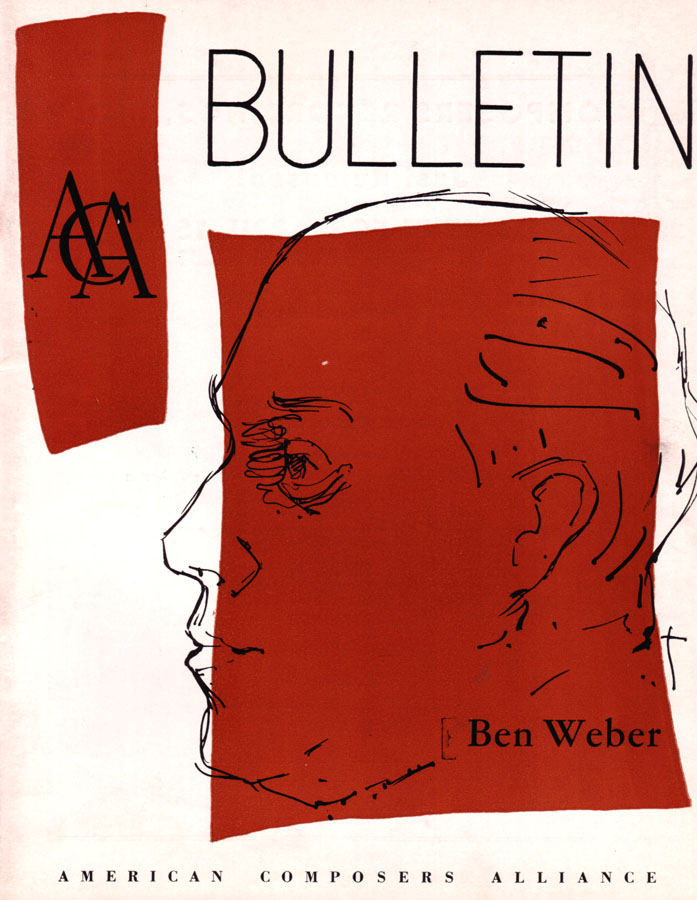
I'm pleased as punch to remind the world that Cursive, my modern chamber group specializing in performing the kind of unknown modern music that gets featured on this blog, has a new program, Imagist Alchemy, coming up this Thursday, October 6, at 7:30 pm at Kenyon Hall, West Seattle's greatest old-timey theater.  The program will feature works for different combinations of voice, flute, viola and cello by mid-century American composers inspired by the Imagist poetry movement of the first half of the 20th century.  The composers include the likes of David Diamond, Adolph Weiss, Paul Pisk and Ben Weber, and Re-Composing is finally going to put the spotlight on these forgotten (some more than others) composers in the days leading up to Imagist Alchemy's big show.  Our Cursive previews are ending today with one of the most appropriate composers for this blog since its inception, Ben Weber (1916-1979).

Hailing from St. Louis, Weber accomplished the curious feat of establishing a position of success and acclaim for himself during the American classical boom years of the 1940's and '50's while not experiencing any of the public adoration that contemporaries like Bernstein, Piston and Schuman got.  Weber was largely self-taught, and while that can sometimes reap popular benefit (such as with the popularly eccentric Paul Creston) his inspiration came from more dodecaphonic climbs.  Weber was one of the first composer to write 12-tone music in America, breaking that new ground with Wallingford Riegger in the late '30's, but rather than adopt the Second Viennese School's attitudes and ascetic aesthetics Weber decided to use dodecaphonic music in a more Romantic Way.  For example, take his ravishing Violin Concerto:


This certainly isn't tonality but it sure ain't Webern, either.  Ben Weber understood how serialism could be used as a tool first rather than a philosophy, as merely a way to keep the composer honest in his atonal dealings and to avoid too cozy familiarities.  And there are cozy familiarities here, too, but primarily in tone and passion.  There's an enormous sweep to this piece, with thick, resonant chords and classically successful orchestration, and the violin part is one of the great Tall Dark Strangers of the rep.  I'm of the mind that trained musicians can "sing" through anything as long as the composer writes likes they want them to, and this is expressed gorgeously by this performance by violinist Oliver Colbentson with the Nurmberger Symphoniker under the direction of Werner Heider, another composer who might drift to these blogly shores.  I'm always impressed with composers who can accentuate tension and release atonally and Weber is one of the best I've seen from America at that.  A more placid example of his language is his brief pedagogical piano piece New Adventure, played here by some guy*:


This little number was published by Theodore Presser as part of the Masters of Our Day series in the '50's, edited by Isadore Freed and Lazare Saminsky (two more guys who are bound to appear on these blogs).  While his piano works, such as this one, are largely as neglected as anything else he's written, one piece has become his best candidate for longevity: the Fantasia (Variaitons), op. 25.  Written for the great William Masselos, the Fantasia is arguably his most representative statement for the instrument, showcasing not only his prowess with dodecaphonic composition but also his sense of melody and emotional power.  It was recorded brilliantly by Stephen Hough in the late '90's for an album that also featured Copland's Piano Variations, Corigliano's Etude Fantasy and Tsontakis's Ghost Variations (a hell of a program, to be sure).  That CD also marked the last time a Weber piece was commercially recorded, and searching on YouTube reveals that it might be the last time it was performed for posterity, either.  The good news is that a number of excellent pianists have taken a crack at it, such as Christopher Czaja Sager in this 1972 performance:


That recording is a bit scratchy but it's all there - confident, exciting piano writing, wild yet refined variation and a glorious clash of tonal memories and atonal virtuosity.  If it was the only Weber piece to get played again in the future I wouldn't be too sore about it, and thankfully it's still in print through Sheet Music Plus - oh, wait.  More tangible good news is that many of his pieces remain in print, including dozens through the ever-essential ACA (such as his one ballet, The Pool of Darkness, another piece that begs to be performed by Cursive), and all the published ones can be got through Interlibrary Loan and copied.  It's through libraries that I got his Four Songs for voice and cello, a work featured on Imagist Alchemy.  Combining the poetry of Ezra Pound, a man at the forefront of Imagism and who famously cheerleaded for classical Chinese and Japanese poetry, with ancient Latin and Sanskrit poetry, including one by Emperor Hadrian himself.  The concert isn't coming a moment too soon, either, as this year, one that is three quarters over already, is the Centenary of Weber's birth, though sadly I haven't heard of any other groups taking charge and performing some of his many worthy compositions.  The last time there was an all-Weber program was likely this retrospective concert on the 20th anniversary of his death, one that featured his works for the combination of flute, cello and celesta, one so cool I wish I'd thought of it first.  That concert featured tribute works by Milton Babbitt, Ned Rorem (who performed the piece himself) and Lou Harrison, and all around sounded like a lovely time.  Hopefully Cursive's performance Thursday night will add a little notch more to Weber's performance pole, and there's always more room for a lyric serialist in the future.


~PNK

*I should have "Some Guy" as a title on my business cards.

Tuesday, October 4, 2016

Special Cursive Preview - Adolph Weiss, an Expressionist from Baltimore


While the American Dream can mean a lot of things, it's a sad fact that 90% of achieving it is being born in America - though that doesn't always serve one well.  Case in point, Adolph Weiss, a man who followed his heart and honed his craft, only to see himself never rise above the B-minus list of American composers.

Today's Cursive preview, spotlighting composers featured on Cursive's new program Imagist Alchemy (Thursday, October 6, 2016 at 7:30 at Kenyon Hall, Seattle), focuses on one of the first Americans to study with Arnold Schoenberg in Vienna, Adolph Weiss (1891-1971).  Born in Baltimore a few years before Walter Piston and nearly a decade before Aaron Copland, Weiss inherited his compositional ambitions from his father, who was himself a student of one of Classical music's most accomplished eccentrics, Ferruccio Busoni.  He worked with Schoenberg in the 1920's at the Academy of Fine Arts, eventually settling in New York and flying right out of the gate on a modernist rocket bike.  While most of America wasn't used to music more modern than this, Weiss was composing this:


The Chamber Symphony is a choice genre that gained vogue among a select few composers of the first half of the 20th century and then again in the latter half, which is to say that it didn't really gain vogue but some fabulous people worked in the form, including Schoenberg, George Enescu, Franz Schreker and John Adams.  There's far more to unpack than we have time for here but I'll try to shake out a short version.  This is one of the firmest statements of Expressionism I've heard from an American composer (though at this point still working in Vienna), full of breakneck mood shifts and bursts of mad abandon.  Imitative counterpoint and organic development is the name of the game, though I'd class this as a far cry from Beethoven in that regard.  The woodwinds-heavy texture,  lets instruments get caught in strange loops and zoom around in nutty logic.  This is helped here by a wonderful performance that infuriatingly goes uncredited, even though someone in the comments section has already asked who the performers are, and there's no commercial recording of this piece I know of.  The spirit of expressionism is perfectly captured around 6 minutes in, where icy, spasming flutes accompany a rapturous cello solo - the passionate and the insane, together at last.  It's a brilliant and dense 16 minutes and I can't believe that I have no idea who's performing it here.


One work of his that did get a commercial recording is his Theme and Variations for orchestra, written nearly a decade after the Chamber Symphony and sounding quite a bit more like another American Expressionist, Carl Ruggles.  The statement of the theme is a crowded subway of deeply buzzing chords, hiding the theme itself in the upper lines and creating an impression of spotlights progressively shining up the lengths of skyscrapers.  The pacing is more erratic here, eschewing the blinding arpeggiation of the Chamber Symphony in favor of oblique dramatic statements, and while I can't say that I enjoy it as much as the Chamber Symphony its architecture is certainly compelling and it's a bold and dangerous creature of its time, riding the wave of High American Modernism to the very top before it fell back in the populist wave of the late Depression.


Weiss was among a highly select number of bassoonist composers, and at 16 was even in the Russian Symphony Orchestra of New York, joining the New York Philharmonic under Gustav Mahler the following year.  It's perhaps because of this woodwind-centered background he contributed some highly substantial works to the woodwind repertoire, including this major Trio for clarinet, viola and cello in 1948, a work simply begging to be performed by Cursive.  If the Theme and Variations was too dense and stately for your tastes the Trio gets back to Weiss's roots with a lot of mysterious, liquid interplay between the three voices and an off-kilter, sometimes jaunty sensibility.  It's chamber music at its most intimate, suitable for the living rooms of the excellently demented.  It's in the description of the video for the second movement of this piece, by the way, that I found the best information on Weiss's method in the web, in the form of program notes by possible future Re-Composing subject Lester Trimble:

Adolph Weiss has been referred to as "Schoenberg's first official American student in Germany." He did indeed spend an important period of study with Arnold Schoenberg at the Berlin Academy, which led over the years to an easy camaraderie with the 12-tone system and with serial technique in general -- in short, with the "numerology" of advanced music -- to the extent that his compositions are created first in purely numerical form. They are written in columns of figures on the pages of a simple, loose-leaf notebook. [No Excel in 1948 . . .] Then, when the words have been completed in every detail, they are transcribed upon score paper in conventional notation. It is a startling experience to observe the composer at the piano, playing a new, untranscribed composition from an enigmatic page of small dots, lines and numbers.

This does not mean, as one would assume, that Weiss is straightjacketed by any "logic of numbers." On the contrary, he finds freedom and endless stimulation toward new musical ideas in a tone row, and, as his attitude toward composition is unusually fun-loving and spontaneous, his musical fantasy remains unfettered. Somehow, in his career as a composer, he has acquired an uncanny facility with numbers. He can work in them more conveniently than in conventional notation, and, concomitantly, finds his thiking dis-encumbered from traditional habits of five-line staff writing. The music, however, is "heard" before it is written; numbers and notes are simply the graphics of sound, and Weiss employs them as such.

The Trio for Clarinet, Viola, and Cello is formed in two movements, marked respectively Andante and Allegro Molto. Both movements are characterized by a high degree of compositional complexity, with intervallic leaps accounting for much of the melodic movement. The Allegro Molto is, in character, a Scherzo. It remains in 2/4 meter throughout, with cross-accents and fast imitative interplay imparting an almost breathless quality to the music. Occasional disguised references are made to thematic material of the opening movement, while several of the rhythmic motifs have a distinctly retrospective flavor. Here, as in the Andante, the linear approach predominates.


Never in my life would I have guessed such a bizarre method from music that sounds so, well, not written with numbers first and notes at the very end.  For example, one piece of his to get commercially recorded that hasn't made its way to YouTube is his "Scherzoso Jazzoso" American Life, available to listen here in the form of a 30 second snippet.  As jazzy as it undeniably is Weiss still obeys his Expressionistic sense of phrasing and eruptive gestures.  A piece that has no recording whatsoever, especially not a commercial one, is the work that Cursive is performing this Thursday night, the 1930 Sonata for Flute and Viola.  While I don't want to spoil too much you can expect a lot of bewitching modalities, imitative counterpoint, virtuosity and occasional rude shrieking.  And what better way is there to use the flute/viola combo than rude shrieking?

Well, maybe that was the problem, as Weiss's obvious talent and passion never materialized in much public exposure.  The serious lack of commercial recordings is sad but understandable, as the American market never fully supported music like this, even in the heady years between the Wars.  Weiss kept on keeping on until his death in 1971 and with a little elbow grease and access to Interlibrary Loan services we might be able to unearth more forgotten gems by America's first Second Vienneser.


PNK

Monday, October 3, 2016

Special Cursive Preview - David Diamond's Vocalises


I'm pleased as punch to announce that Cursive, my modern chamber group specializing in performing the kind of unknown modern music that gets featured on this blog, has a new program, Imagist Alchemy, coming up this Thursday, October 6, at 7:30 pm at Kenyon Hall, West Seattle's greatest old-timey theater.  The program will feature works for different combinations of voice, flute, viola and cello by mid-century American composers inspired by the Imagist poetry movement of the first half of the 20th century.  The composers include the likes of David Diamond, Adolph Weiss, Paul Pisk and Ben Weber, and Re-Composing is finally going to put the spotlight on these forgotten (some more than others) composers in the days leading up to Imagist Alchemy's big show.  I can't say I'll be able to cover all of them but there's still plenty to talk about, starting with a warm return to one of the former biggest stars in American music, David Diamond.

I previously covered Diamond's haunting piano miniature The Tomb of Melville, and hopefully I made a case for it being one of the most beguilingly lovely piano pieces in American music.  It's absence from modern recitals, or recitals in general, is only partially understandable by its limbo state of out-of-printdom, as Diamond used to be as big a name as Schuman, Harris and Piston.  Best known for his string orchestra piece Rounds, Diamond's signature works show off one of the most skilled and assured voices in the big American national style of the '40's and '50's - modal block chords, expert counterpoint and lots of 'Merican 'tude.  That doesn't mean that all of his works sound the same of course, and for maximum Diamond variety one should turn to his later works ('60's and forward) and his earliest works from the '30's, such as his ballet TOM.  These early years are what we're examining today with one of his first works, soon to be featured by Cursive in Imagist Alchemy: Vocalises for voice and viola.


Voice and viola works are elusive and alluring beasts, possessing a warmth and darkness because of the instrumentation but never getting performed.  This piece is a trio of vocalises, so the voice sings on an open syllable, allowing itself to weave through the viola's copious double stops with a snake-like silkiness.  Diamond was only 20 when he wrote this, meaning that he was under the tutelage of Nadia Boulanger, American music's favorite French auntie, and it's very easy to see the Old World influence in this piece.  It's not just Francophonic, either, but vaguely Renaissance, the lilting melodies and stark chord progressions highly reminiscent of an Old Master landscape.  One could also point to Christina's World, one of the most famous paintings in the whole world, and I'd like to think that Old World and New World landscapes aren't mutually exclusive.  The version we're playing is slightly modified to accommodate a flute, but don't let that deter you, as flute and viola are a fascinating combo in themselves and the musicians are much boss.  Here's a splendid recording of the original that really brings out the bucolic solitude of the piece, and here's to wishing all my readers a happy time checking their schedules to see if they can make the concert.


~PNK